
This morning, Nvidia unveiled twelve
new high-definition Mobile Internet Devices (MIDs) to the world, which include
an assortment of netbooks and tablet PCs.
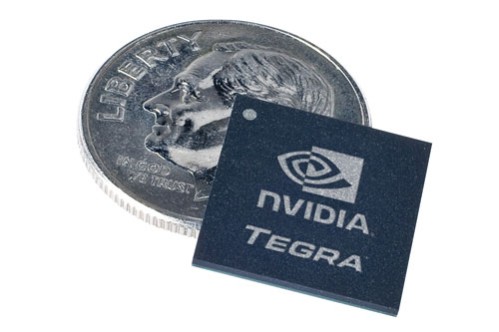
Tegra is Nvidia’s version of the CPU, although ARM-based, and supports
rich high definition graphics processing, Flash video acceleration, and always on
operation at physical size smaller than a US dime. On June 2nd last year, we covered
a prototype MID device during a pre-Computex press conference that looked like a fat iPhone.
On today’s June 2nd, Nvidia is announcing that over twenty Tegra-based projects
are currently in development, and those attending Computex will be able to get
a taste of a few that are to be released shortly.
“The mobile computing revolution has arrived,” stated Michael Rayfield,
general manager of mobile business at NVIDIA. “These new Tegra-based products
combine excellent Internet and media capabilities, always-on operation, and
wireless connectivity for the un-tethered Internet experience consumers have
been craving.”
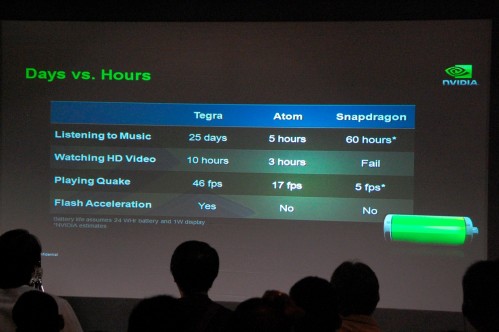
Nvidia claims that Tegra processors achieve up to five times the power
efficiency of existing products in battery-operated systems. More specifically,
Tegra-based MIDs can deliver up to 25 continuous hours of music playback on one
charge and up to 10 hours of 1080p HD video playback. It also stated that the
devices can “play video games a 46 frames per second,” but we have no idea how
on earth they came up with that number given the complexity of performance
variables in today’s games.
Is it important to note that Tegra is a heterogeneous multiprocessor
architecture. When an internet browser is opened for instance, a CPU will
process HTML and Java code while an HD video processor like Tegra can process
HD video content to the display using GPU-based acceleration. This
heterogeneous platform is what that Nvidia wants to build on, the idea of two
or more uniquely architected types of processors working together on individual
segments of the entire user experience.

Published in
News
Nvidia introduces 12 new Tegra-based devices


Mostly netbooks