Index
Review: Superior auto-overclocking
So far, Nvidia launched two cards based on the GT106 GPU – the GTX 660 and GTX 650 Ti. Our today’s guest is the GTX 660 Ultra Charged graphics card, which should provide for pleasant gaming at 1080p. Although we’re reviewing the GTX 660, we think it’s important to explain why the same GPU isn’t as fast on the GTX 650 Ti as on the GTX 660.
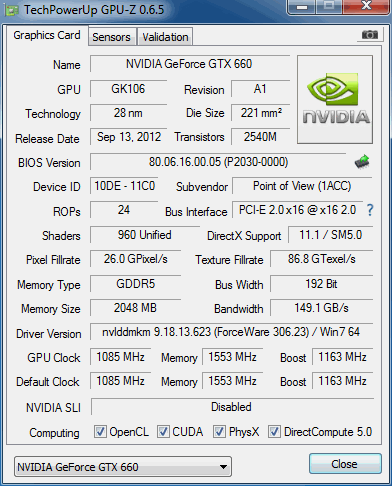
The GTX 660 packs 960 CUDA cores, while the GTX 650 Ti has 768. The GTX 660’s GPU clock is 980MHz while the GTX 650 Ti’s stands at 925MHz.
The GTX 650 Ti’s GPU is a cut down version that has less ROPs and texture units than the GTX 660’s – 16 vs. 24 ROPs and 64 vs. 80 texture units, respectively.
Additionally, the GTX 650 Ti doesn’t feature GPU Boost technology that would automatically overclock the GPU, which can be found on the GTX 660. The GTX 660’s reference Base clock is 980MHz, but the GPU overclocks to 1033GHz+ when there’s thermal and power headroom.
The GTX 660 also has a bandwidth advantage, since it has three 64 bit memory controllers (192-bit memory interface) and 144GB/s bandwidth. The GTX 650 Ti has two 64-bit memory controllers (128-bit memory interface) and 86.4GB/s bandwidth.
The picture below shows Point of View / TGT GTX 660 Ultra Charged graphics card that has a factory overclocked GPU and memory.
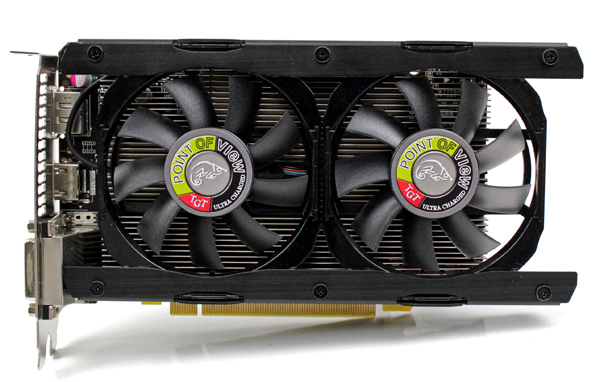
The card you see belongs to LLS series (Low Leakage Selection). This implies that the Ultra Charged’s LLS GPU should deliver superior auto-overclocking compared to the standard GTX 660. In other words, the Ultra Charged’s clock distribution should beat that of regular GPUs found on the rest of the GTX 660 pack. Of course, TGT’s tuning utility, aptly named Big Bang, will be of much help in this task. In case you didn’t know, the utility was developed by TGT exactly for this reason – making LLS chip selection easier, and you can find it, here.