Index
The mic is easily removed - all you need to do is guide it from the standard position (first picture below) into the one for removing (second picture below) and tug it lightly.
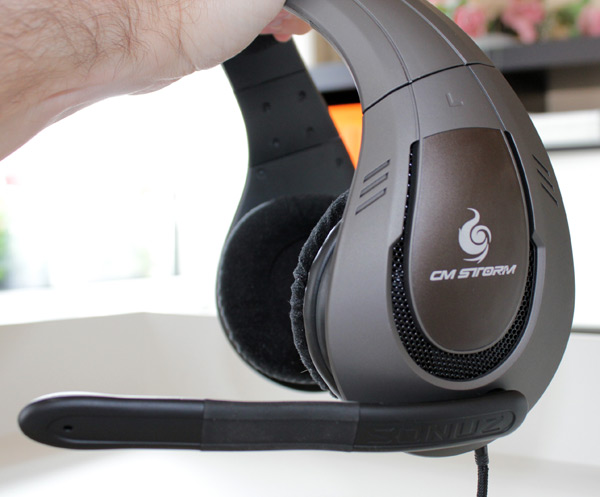
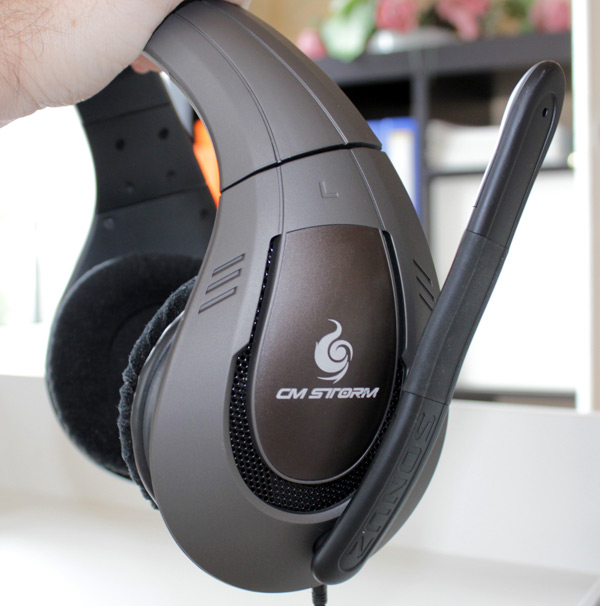
The mic can be placed both left and right. Cooler Master ships a rubber plug that will come in handy when the mic is not in use.
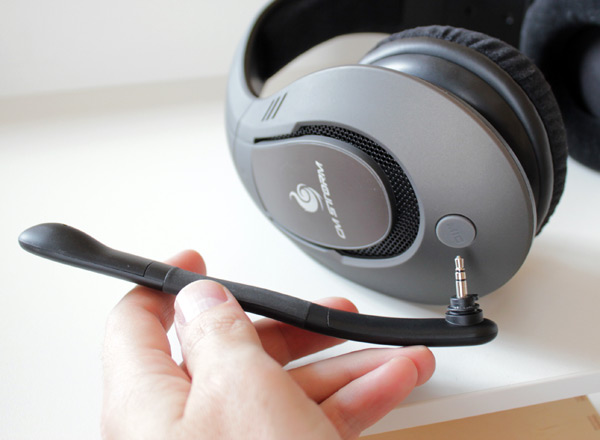
The mic is very robust but can bend a bit in the middle. 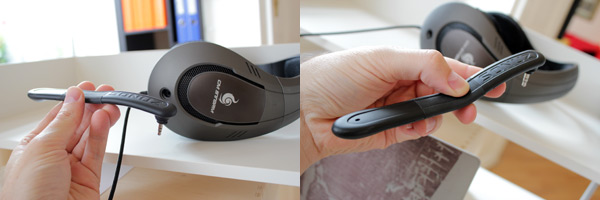
The mic is omni-directional and sound quality is really good. Our voice was heard very clearly and background noise is minimal. Specs-wise, the microphone boasts a frequency response of 100 Hz – 10.000 Hz with sensitivity of -47 +/- 3dB @ 1kHz and 1V/Pa, and a signal to noise ratio of 58dB. The mic can be turned on/off via the in-line remote
The headphone boasts a frequency response of 10 – 20,000 Hz, an impedance of 45 ohms, and sensitivity of 98 +/- 3dB @ 1kHz and 1V/Pa.
The speaker houses a large 53mm driver and of course, we're talking about a stereo headset. Of course, analog headsets require quality soundcards to reproduce the entire spectrum but we found the sound quite good, regardless of the device we used it on. The bass is heard quite well. Note that the Sonuz was noticeably quieter than the Sirius headset.
Sonuz doesn't have the surround sound solution like on the Sirus, which is evident during gaming. Of course, we doubt you'll lose a battle over it, but we didn't mind. The simulated surround is good, but it's difficult to tell whether the sound is coming from behind or front.
The in-line remote lets you control levels but don't forget about the volume controls inside your OS. Additionally, remember to turn the sound down before you take the headphones out, because music going off full volume in the middle of the night is not a nice suprise.
Anyone who has tried the Sonuz was quite pleased with the sound quality. Mid and high frequencies are clear but the highs are a bit muffled when the sound is maxed out. A couple of friends who tried them said they didn't even notice the bump in the earpads, while others noticed it but did not mind. Only one friend, who happened to have a bit larger ears, said that his ears were a bit sore after longer sessions, specifically at the point where the bump and the ear meet.
Even the youngest member of the crew caught the beat when he strapped the headset.