Index
Review: More affordable alternative to GTX 680 SLI/GTX 690
So far we've had a few GTX 670 graphics cards in our tests. Throughout the tests, we've seen that overclocked GTX 670 cards can score comparably to GTX 680 and what's even better, many of Nvidia's partners offer factory overclocked GTX 670s running at GTX 680 clocks. One such card is Gainward's GTX 670 Phantom 2GB.
The Phantom's GPU runs at 1006MHz while the memory is at 1527MHz. Note that the reference clocks are 915MHz for the GPU and 1502MHz for memory.
An important difference compared to the GTX 680 is that the GTX 680 comes with eight SMX units and 1536 CUDA cores (each unit containing 192 CUDA cores), while the GTX 670 has seven SMX units and 1344 CUDA cores. Nvidia kept the identical memory system used on its GTX 680 card, meaning four 64-bit memory controllers (256-bit memory interface) and 2GB of GDDR5 memory.
We already tested the GTX 670 Phantom, here, and today we'll show you what it's capable of when running in SLI. What we're particularly interested in is the price-performance ratio. We're hoping that two GTX 670 Phantom cards will score similarly to two GTX 680, which would mean that they outscore a single GTX 690. Note that buying two GTX 670 Phantom cards can save up to 250 euro compared to two GTX 680 cards or a single GTX 690.
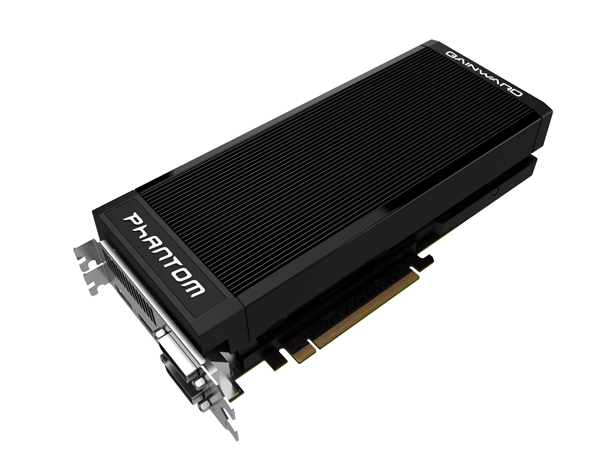
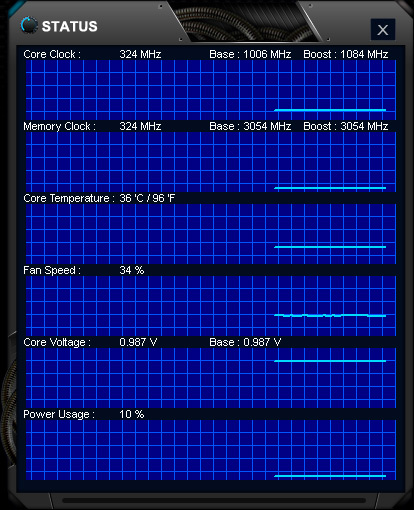
With the launch of GTX 670, Gainward launched a new version of its ExperTool, which is now in version II. ExperTool allows for overclocking Kepler based graphics, displaying sensor readouts or doing simple fan RPM control. It looks much better than the previous versions as well. You can find it here. We must say it would've been great if Gainward threw in a sensor readouts for the second card in SLI chain as well.
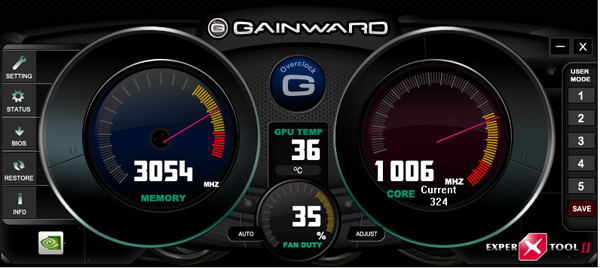
Tha card comes in a really neat looking box with a handle for carrying.