Featured Articles

After USA Nvidia’s Shield comes elsewhere

After USA Nvidia’s Shield comes elsewhere

Project Shield, which is now called Nvidia Shield, is up for preorder, at least if you’re in North America. For…

More...
Nvidia won most Haswell high-end notebooks

Nvidia won most Haswell high-end notebooks

Our sources in the Far East are claiming that most Haswell notebooks that are coming out in the next few weeks…

More...
Microsoft officially announces the Xbox One

Microsoft officially announces the Xbox One

As announced earlier, Microsoft has now finally unveiled its next-generation console, the Xbox One. Although it did not shed much light…

More...
AMD poaches more Nvidia talent

AMD poaches more Nvidia talent

AMD has apparently managed to grab yet another high-ranking Nvidian, but this time it was no engineer or developer.

More...
HIS iCooler Turbo HD 7790 reviewed

HIS iCooler Turbo HD 7790 reviewed

Today we’ll take a closer look at a factory overclocked HD 7790, courtesy of HIS. The HIS HD 7790 iCooler Turbo…

More...
Frontpage Slideshow | Copyright © 2006-2010 orks, a business unit of Nuevvo Webware Ltd.
Wednesday, 06 June 2012 20:47

EVGA GTX 670 FTW reviewed

Written by Sanjin Rados

thumbrecommended08 75

Reivew: For The Win wins


Our today’s task is to see whether EVGA’s GTX 670 FTW is really a graphics card for the win, or the FTW (For The Win) moniker is just a marketing ploy. Namely, we’re hoping the GTX 670 FTW will fare really well when it comes to noise, overclocking and, thanks to the high factory overclock, performance as well. If you’re looking at the picture below and wondering how can this be when EVGA used reference cooling, the trick is that this is reference GTX 680’s cooling. In fact, EVGA also took the reference GTX 680’s PCB as well.
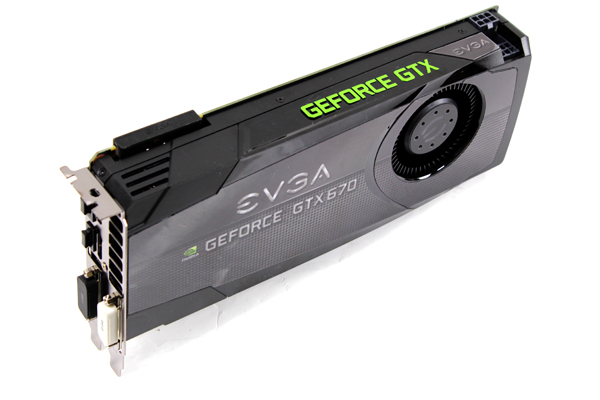
670ftw1

The GPU is overclocked from reference 915MHz to 1006MHz, while the memory is up from reference 1502MHz to 1552MHz (6208MHz effectively).
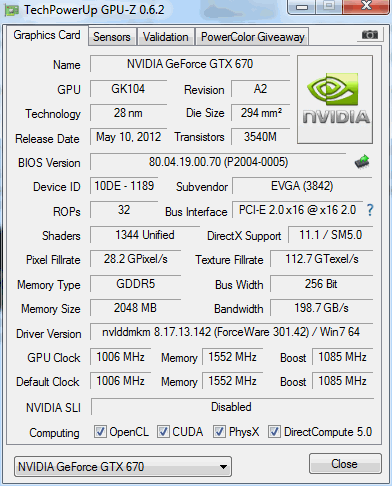
gpuz

GTX 670 and GTX 680 graphics cards use the GK104 GPU. EVGA set the GTX 670 FTW’s clocks at 1006MHz, which is the reference clock on the GTX 680. Naturally, performance can’t be the same because the GTX 670 comes with one SMX unit less. This means that the GTX 670 has 1344 CUDA cores while the GTX 680 has 1536 CUDA cores.

Both the GTX 670 and GTX 680 feature identical memory subsystems, packing four 64-bit memory controllers (totaling at 256-bit) and 2GB of GDDR5. As we already said, EVGA’s GTX 670 FTW comes factory overclocked.


  • «
  •  Start 
  •  Prev 
  •  1 
  •  2 
  •  3 
  •  4 
  •  5 
  •  6 
  •  7 
  •  8 
  •  9 
  •  10 
  •  Next 
  •  End 
  • »
(Page 1 of 12)
Last modified on Thursday, 07 June 2012 09:45
blog comments powered by Disqus

To be able to post comments please log-in with Disqus


Facebook activity

Latest Commented Articles

Recent Comments