“Generally, you can’t see a bit of memory, because it’s too small,” said Tour, Rice’s T.T. and W.F. Chao Chair in Chemistry. “But silicon itself is not transparent. If the density of the circuits is high enough, you’re going to see it.”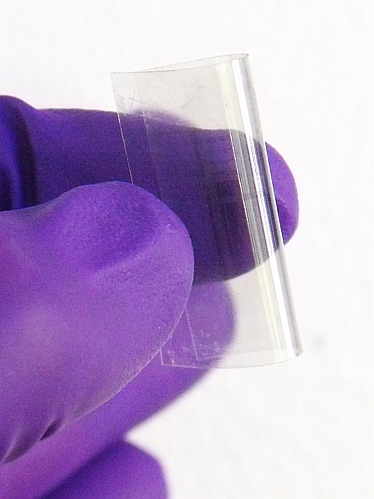
Transparent memory on plastic substrate. Source: Rice University
The transparent memory breakthrough is based upon a 2010 chemistry discovery that pushing a strong charge through standard silicon oxide, an insulator widely used in electronics, forms channels of pure silicon crystals less than 5 nanometers wide. The initial voltage appears to strip oxygen atoms from the silicon oxide; lesser charges then repeatedly break and reconnect the circuit and turn it into nonvolatile memory. Nevertheless, a smaller signal can be used to poll the memory state without altering it.
Just as with Intel's 3D-stacked transistor approach in Ivy Bridge processors and beyond, researchers at Rice hope to develop a transparent memory device that can be stacked in a three-dimensional configuration and attached to a flexible substrate.
A full overview of the discovery, including a video of the work, can be found here.
Published in
News
Flexible transparent PC memory achieved in chemistry lab

Transparent smartphones, tablets on the horizon
Researchers at Rice University in Houston, Texas have recently made a breakthrough in the development of transparent, flexible computer memory using silicon oxide as the active component. According to university chemist James Tour, the breakthrough could soon allow for flexible, bendable touchscreens, transparent integrated circuits and flexible batteries, among other mobile hardware components.