Featured Articles

Gainward GTX 780 3GB previewed

Gainward GTX 780 3GB previewed

The Gainward GTX 780 is now available priced at about US $649/€649, but we're hoping it will be available for a…

More...
GTX 780 available in US stores

GTX 780 available in US stores

The GTX 780, a trimmed down version of the Geforce Titan, is out and we wrote that almost a dozen…

More...
Newegg claims Shield comes on June 30

Newegg claims Shield comes on June 30

It is no secret that for the last few days you can pre-order Nvidia Shield, at least if you are based…

More...
Nvidia officially launches the GTX 780

Nvidia officially launches the GTX 780

Just as we wrote a couple of days ago, Nvidia has picked the 23rd of May as the official launch date…

More...
HIS iCooler Turbo HD 7790 reviewed

HIS iCooler Turbo HD 7790 reviewed

Today we’ll take a closer look at a factory overclocked HD 7790, courtesy of HIS. The HIS HD 7790 iCooler Turbo…

More...
Frontpage Slideshow | Copyright © 2006-2010 orks, a business unit of Nuevvo Webware Ltd.
Wednesday, 25 May 2011 11:02

AMD E-350 vs Intel Atom D525+ION2 - Power-Consumption

Written by Eliot Kucharik

E-350_vs_D525_ASRock_front_small top-value-2008-lr

Review:
Intel Atom is still dead

Power-Consumption

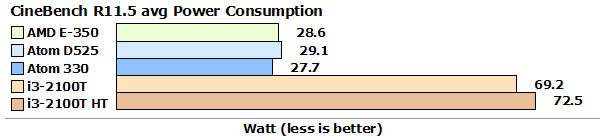
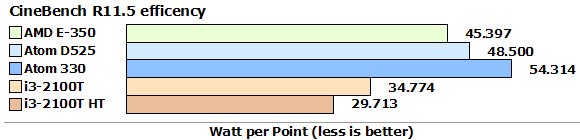
While the ASRock ION 330HT box is an original one, we used a ITX case with 80W PSU for the E-350 and D525. We also removed the WLAN card of the Zotac board, so Zotac has no disadvantage due to an extra card. First, we take a look at power efficiency in Cinebench, meaning under very high and threaded loads.
 

E-350_vs_D525_CBpower


E-350_vs_D525_CBeff

The efficency of both the Intel Atom and the AMD E-350 are dissapointing. Any Intel desktop CPU is more efficient and of course ARM is also miles ahead.
 

E-350_vs_D525_power

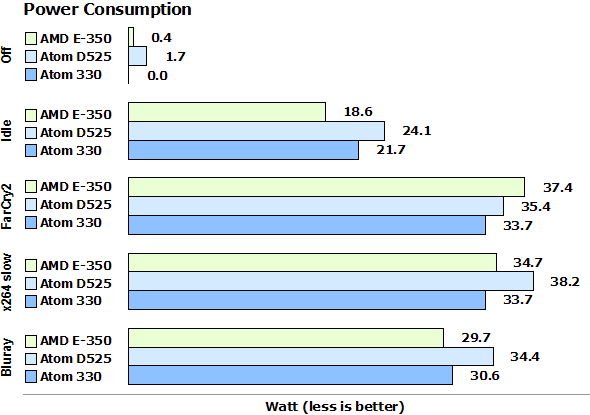
In the power consumption department the old Atom/ION combination still leads slightly but just about 4W more for either Atom D525+ION2 and E-350 are not that bad either. The Zotac board draws 1.7W when switched off, which is dissapointing, while the ASRock ION box did the correct thing and does not use any energy at all. The blu-ray test was done with a file on the SDD, so using a real drive would add about 7-8W.

 

(Page 5 of 6)
Last modified on Saturday, 28 May 2011 00:13
blog comments powered by Disqus

To be able to post comments please log-in with Disqus


Facebook activity

Latest Commented Articles

Recent Comments