Index
- Gainward GTX 470 tested
- GTX 470 Arhitecture
- Packaging, Contents
- A closer look at Gainward GTX 470
- Testbed
- Futeremark Vantage
- Gaming: FarCry2
- Gaming: Crysis
- Gaming: Batman Arkham Asylum
- Gaming: HAWX
- Gaming: Dirt 2
- Gaming: Metro 2033
- Gaming: Unigine - Heaven
- Overclocking, Consumption amd Temperatures
- Conclusion
- All Pages
Page 14 of 15
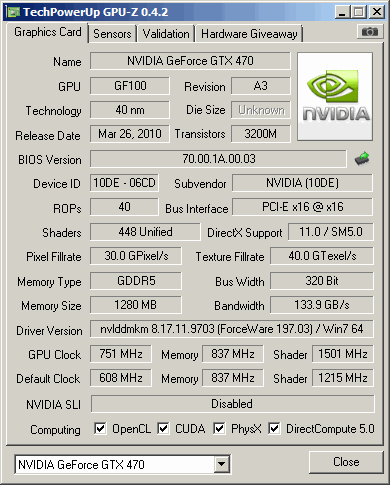
Gainward GTX 470 runs at 607/1215/837 MHz for the GPU/Shaders/Memory – meaning we’re talking about reference clocks. Nvidia strapped the GTX 470 with a dual-slot cooler, but the card easily hits 90° in 3D. The cooler is similar to the one used on the GTX 480, and it uses the same Delta 1.8A fan.
The cooler is capable of keeping temperatures in check, but it does get pretty loud when the GPU heats-up. Still, it’s quieter than the one on the GTX 480. At reference clocks, maximum GPU temperatures didn’t exceed 93°C in FurMark test, and the fan spun at about 3000 RPM. In idle mode, Gainward’s GTX 470 ran pretty quiet.

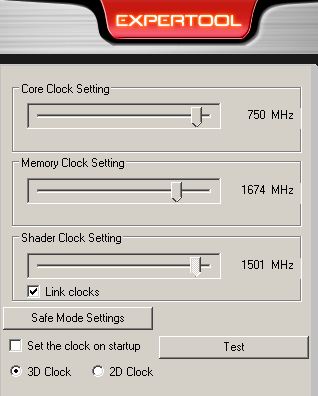
Overclocking always requires some kind of sacrifice – thermals, noise or both. In this case, we had to push the fan to maximum RPM, which made the fan a bit too loud, but GPU temperatures didn’t exceed 83 °C. We didn’t meddle with voltages but managed to push the GPU from reference 607MHz to 750MHz. Overclocking the memory on GTX 400 cards is a bit tough, and we only managed to reach 890MHz (3560MHz, reference is 837MHz). Overclocking brought up to 19.6% better results in FarCry 2.
We used Gainward ExperTool to alter the clocks, but this tool is also in charge of fan RPM regulation. Note however that although GPU and shader clocks can be set independently via their respective sliders, overclocking will only run if the shaders run at twice the speed of GPU.
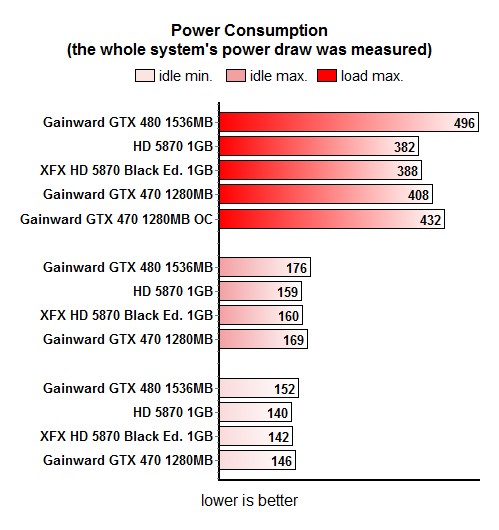
Power Consumption