Featured Articles

Gainward GTX 780 3GB reviewed

Gainward GTX 780 3GB reviewed

The new GTX 780 is a pretty impressive card even in its plain vanilla reference edition and only a handful…

More...
Nvidia to license Kepler to ARM SoC makers

Nvidia to license Kepler to ARM SoC makers

Nvidia can be a bit strange at times and its decision to license Kepler to mobile application manufacturers definitely falls into…

More...
Intel plans Haswell refresh in Q2 2014

Intel plans Haswell refresh in Q2 2014

Intel has been executing its tick tock strategy flawlessly since January 2006 and now there is some indication that we might…

More...
Xbox One demoed running GTX card

Xbox One demoed running GTX card

It looks like the Xbox One just cannot catch a break. We have stumbled upon a report claiming that Xbox One…

More...
EVGA GTX 770 ACX 2GB previewed

EVGA GTX 770 ACX 2GB previewed

Nvidia is hoping that the Geforce GTX 770 will be a very popular product, and EVGA obviously share this view, as…

More...
Frontpage Slideshow | Copyright © 2006-2010 orks, a business unit of Nuevvo Webware Ltd.
Tuesday, 15 December 2009 09:03

G.Skill Eco modules reviewed - 2 Overview

Written by Eliot Kucharik

ImageImage

Review: Low voltage modules can be fast


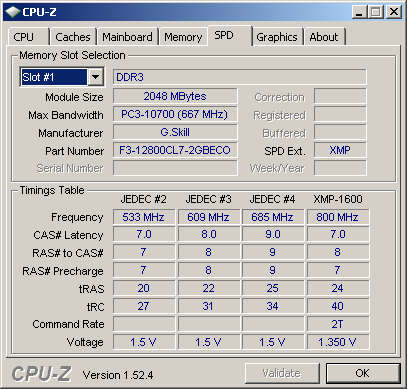
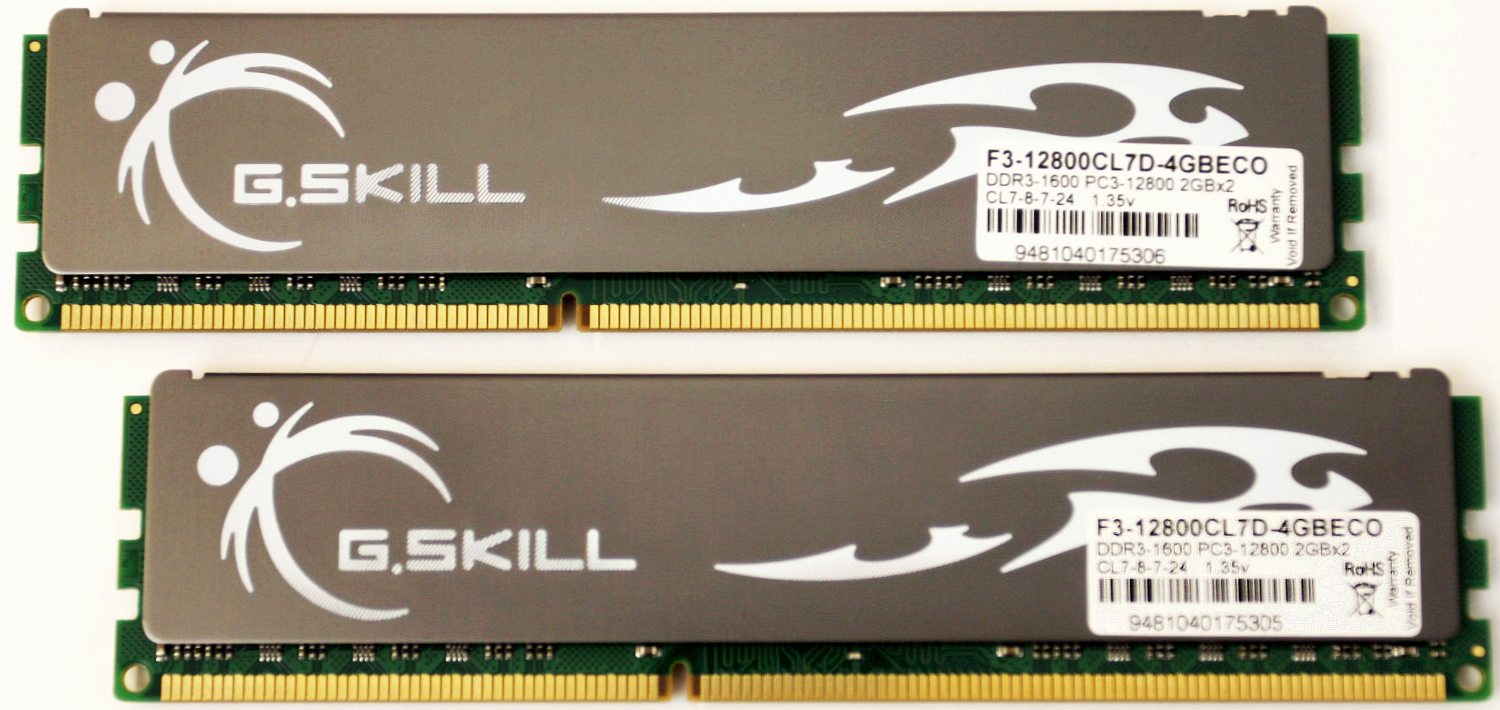
This kit consists of two modules each 2GB. For some reason G.Skill states this modules are only for LGA1156 boards. Of course that statement will not hinder us to try them out on our AMD test rig. The specified rating at 1600MHz and 7-8-7-2T timings at 1.35V is impressive. The SPD is detecting the modules with 8-8-8-1T timings, which we recommend to use. If you need it any faster, you can overclock further. G.Skill assured us, the modules will work fine with voltages up to 1.50V.

For normal operation at 1333MHz you need 1.25V to 1.30V. Our AMD board run stable with 1.248V, while the Intel board did need 1.298V. This may be a problem with the BIOS, because most boards do not detect low voltage DDR3 modules correctly, but we hope these glitches will be fixed soon.

Image


Here is what the SPD looks like:

Image


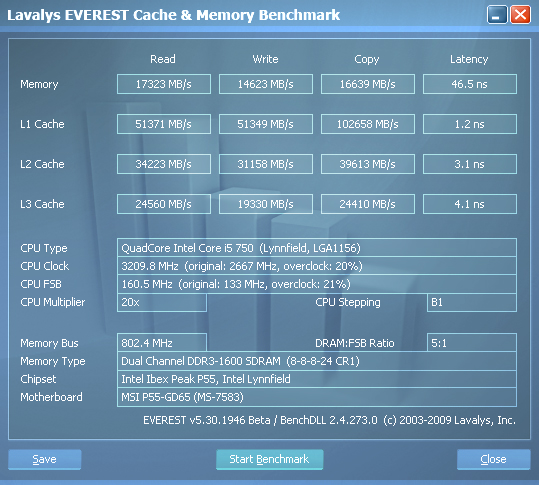
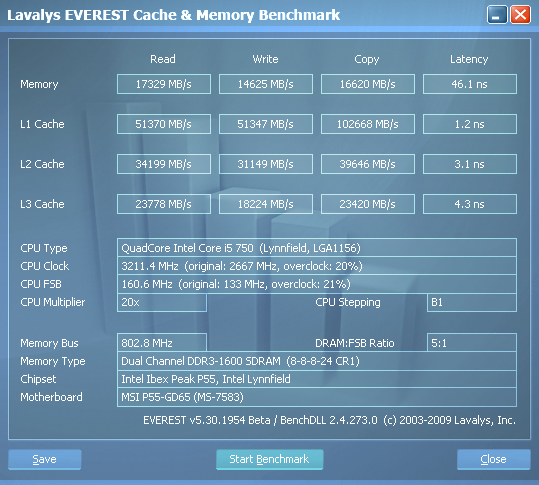
Let's take a look at Everest results, with C-States enabled, running at 1.35V, 1600MHz and 8-8-8-1T.
Image


Not much difference to the Mushkin parts we reviewed recently.

Image


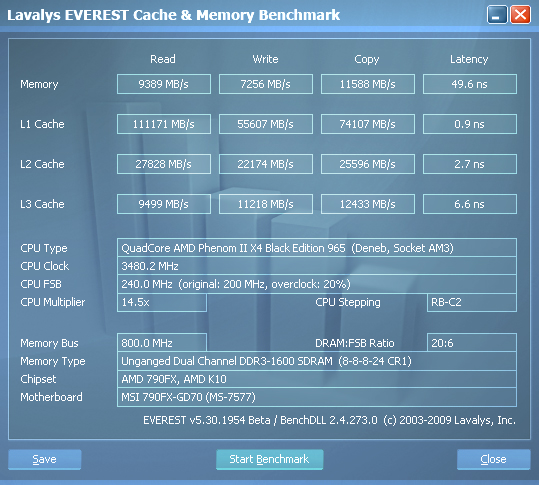
Of course we tested also with AMD, because we think there is no reason why it should not work. Due to a different design the throughput is not comparable to Intel, but the controller can read or write on two channels at any given time.
Image


(Page 2 of 4)
Last modified on Friday, 24 September 2010 22:05
blog comments powered by Disqus

To be able to post comments please log-in with Disqus


Facebook activity

Latest Commented Articles

Recent Comments