
Index
Page 7 of 7
Power Consumption:
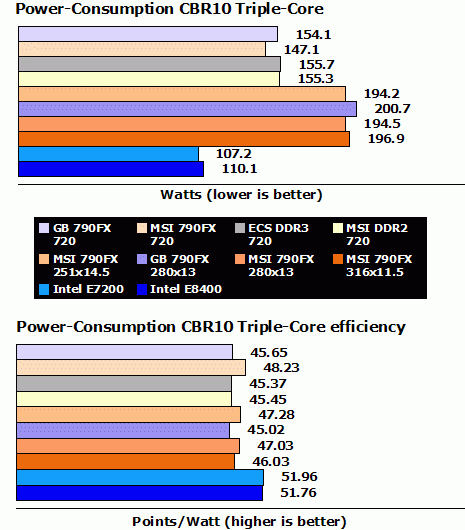
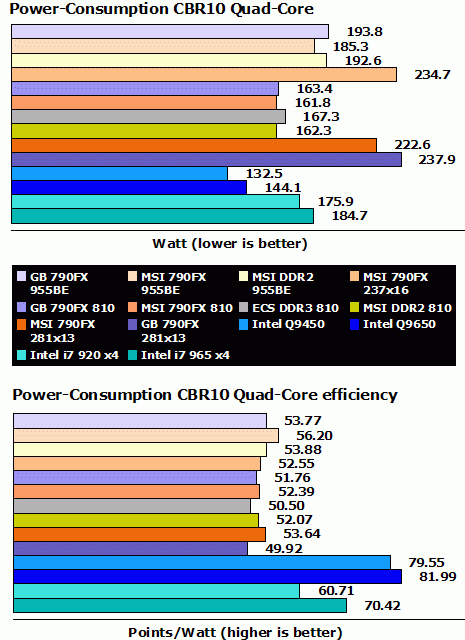
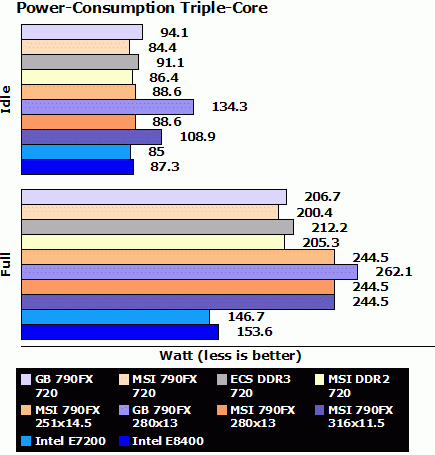
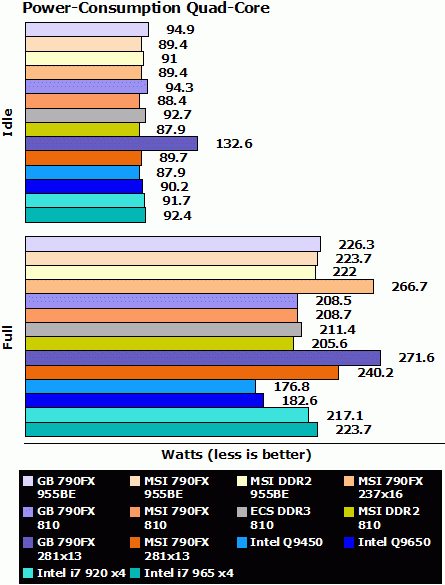
To merely test power consumption is not enough any more and because you dear readers gave us positive feedback. So we measured power-consumption with CineBench and set them in perspective with the results. Please note our results are peak values but that's ok for comparison purposes. Power-Consumption tests for overall consumption were made with Cool'n'Quiet enabled, which does not work on this board if your FSB exceeds 220MHz. Compared to MSI who did built in this option on our (!) request, you see a huge impact at idle powers. Also the VRM layout proves it does not safe energy even at full load.
Conclusion:
In terms of speed this board equals or exceeds the MSI counterpart. There is not much wrong with the layout, besides the buttons, which we would like to see on the "outside" and we don't think it's a smart solution to have cables crossing the board to install eSATA. While we have no critics about a 2oz layer board to keep all parts cool, we don't think the dual lane approach for each phase is a good one. Some years back it was a nice idea to keep voltages stable, but meanwhile with highly integrated parts which can deliver voltages very stable, it's not any more necessary. As we have shown it does not give you any benefit but does increase power consumption.
We think the BIOS can still be enhanced, by removing useless settings such as floppy, COM1 and LPT1 - as long as they are disabled by default. Also the memory did not work with 1600MHz with our modules which of course have not been tested by Gigabyte, because we are using an i7 kit. But they worked with MSI better. And the most important point, to let the users decide if they want to enable Cool'n'Quiet when overclocking.
The board is already available for about €138,- which is about €10,- less compared to the MSI offering.
Overall the board will not disappoint, because it's stable and gives you much room for overclocking. But as the power-consumption tests have proved, one board is still superior to it. But maybe Gigabyte will improve the BIOS, and if they do so, we will report it.
« Prev Next