Index
Page 2 of 5
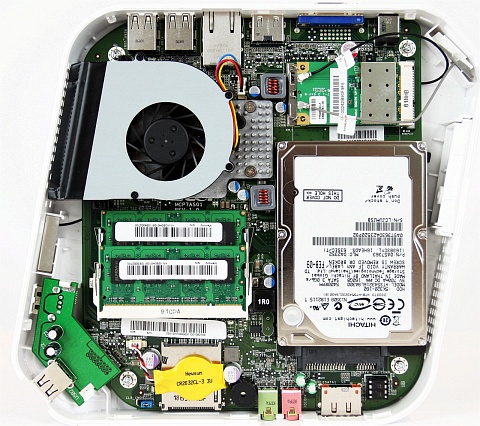
Acer Revo comes with single core Atom 230, 2GB DDR2 memory and 160GB hard drive and since we're a hardware oriented site, it's only natural that we take a look inside that box and show our audience what the Revo is made of:
Click here for a bigger picture.
As you can see, it's nothing like your ordinary ITX or µATX board, it's more a notebook PCB with all parts packed together. The most annoying thing about the Revo is its small fan, top left. It is noisy even when running at only 2000rpm. While the Revo is nowhere as thin as a netbook, there is plenty of space to install a bigger fan which would rotate at a lower rate. Also, a heatpipe-solution, perhaps even a passive one, would be possible.
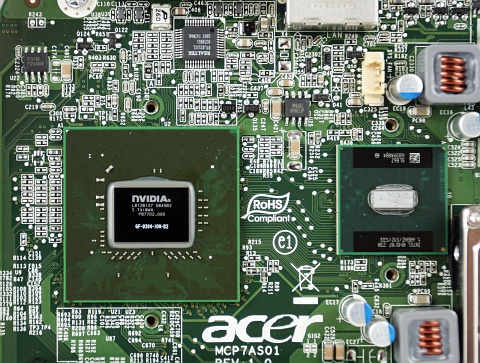
You may remember us praising all the boards which come with integrated MOSFETs, integrated chokes and solid state capacitors. Unfortunately on this board you'll find none of that, so our guess is that Acer did everything to reduce costs. If you remove the cooling solution, first the fan, second the aluminum heatspreader the two chips driving the Revo are revealed:
Click here for a bigger picture.
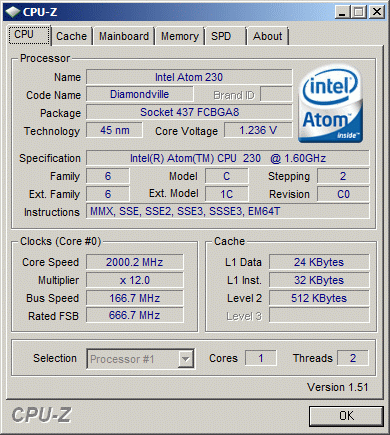
The GeForce 9300 is a downgraded GeForce 9400 which is used in many notebooks, most notably inside Apple's latest MacBooks. Nvidia nowadays calls this simply Ion and leaves Geforce 9300 or MCP79 names for the other markets. The Atom processor is very disappointing, because it's only a single-core which is still slow, especially with Vista installed. Fortunately, the BIOS does allow for a limited overclocking, so we can squeeze out 2GHz instead of 1.6GHz. Single core doesn't really like normal multitasking even when Hyperthreading is supported as it doesn't pack enough horsepower to deal with it. Dual core Atom 330 would definitely be a better albeit a slightly hotter choice.
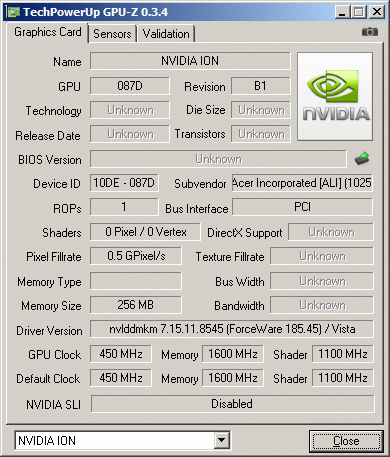
GPU-Z has some troubles showing all the data. Of course the chip does not use any dedicated memory, but borrows 256MB from the main-memory in auto-configuration. The BIOS allows to set values of 32MB, 64MB, 128MB, 256MB and 512MB. We left the setting on auto, but even 128MB would be sufficient for running Aero on Windows Vista.