
Power consumption:
While the system is idling, VIAs CPU/chipset combination is beating Intel by a huge margin. The comparison is not quite fair, because the Nano board has many more features which should use more power. It has a PCIe Gb LAN and and a second PCI LAN, besides support for Flash and RAID for up to four hard drives. To keep it quite fair, we used only one memory module even when VIA is supporting two modules. Using a Radeon HD3870 we had to use a normal ATX power supply, the lowest we could find. Trying to use such a power-supply without additional graphics-card could cause the Nano board not to boot up because the power demand is too low for the PSU to kick in. The higher-end PSU you use the more likely that would happen.
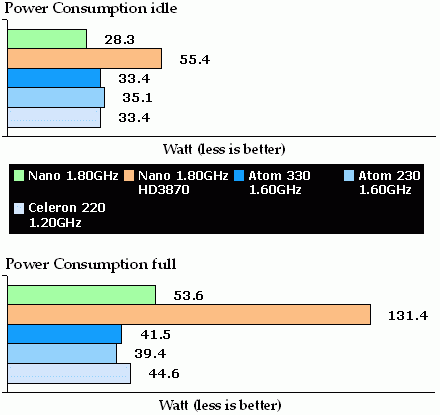
Idle power is impressive, but under load the Atom built-in a 45nm process gets the lead. Even a single-core Celeron is leading. Adding a graphics-cards which was considered high-end a year ago gives you 80W higher power-consumption. Sadly, there are no 80PLUS PSUs with a 200W output rating.
Conlusion:
The Nano is a huge step for VIA to get competitive in the CPU market again. The sad part is that we doubt we will see many nice and affordable Nano-based desktop boards from VIA any time soon. Currently, VIA concentrates on the embedded market and have now improved their position. VIA also wants to aim at the Netbook market and HP is probably the first to launch a Netbook that can compete versus Atom and we believe that this will happen by the end of the year.
Although it's built in 65nm, VIA impresses with idle power-consumption, considering that the next lower model called L2200 and clocked 200MHz less can do even better. Atom, in contrast, is built in a 45nm process, which gives Intel at least an economical advantage. The TDP of the Nano L2100 - yes, lower number is higher clocked - is 25W, which is six times higher than Atom, the next lower model, L2200 is rated at 17W while the 1.3GHz models need only 8W. VIA is still doing great, as its chipset consumes much less compared to Intels 945GC/ICH7 combination.
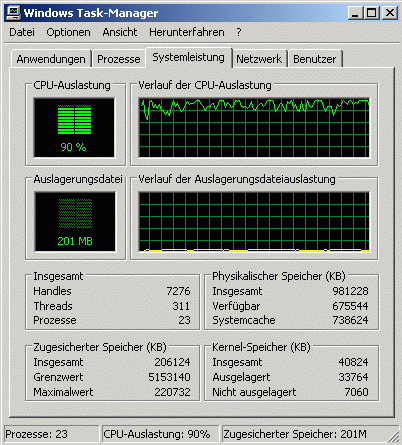
With the new board we were able to play 720p movie-files. It seems that hyper-threading gives Atom a small advantage in this test. The problem seems not to be the CPU itself but the compilers, because most of them are optimized for Intel CPUs. We wish VIA would also help the guys coding ffdshow to get the maximum out of their CPUs.
VIA is working on a new chipset which will also support VC-1 and h.264 hardware-decoding meaning quasi-integration of their S3 Chrome ULV GPU into a chipset which would give them an edge over Intel.
Even being on the right track, VIA needs to further improve their CPUs, a dual-core Nano in 45nm would greatly help the cause. VIA might always be more expensive compared to Intel, but we hope to see VIA boards from other vendors which will do a little competition for Intel. Atom 230 boards are available for under €50, the dual-core Atom boards in the market for under €70, so this will be a hard task.
At least Nano is faster than single-core Atom, the combination with VIAs chipset more power-efficient when idling. In the Netbook market, when it comes to performance and battery life, the VIA Nano is a clear winner.