
Page 2 of 3
Benchmarks:
Please note that different bios revisions may give different results. All benches are done with AUTO settings without altering any BIOS option besides CPU VCore, NB VCore and FSB Termination Voltage.
x264:
x264 is a h.264/AVC codec which supports four threads, and it's available for free. We took a PAL episode of "Babylon 5" with a length of 41 minutes, 57 seconds and 8 frames. We tried to "emulate" the most common usage when you encode your movies:
1st: We have a perfect master, so we only de-interlace the content and resize it without any other manipulations; we marked this as "fast."
2nd: You get bad mastering on many DVDs, especially "old" stuff or when the studios are in a hurry for the release. In this case you want to improve the picture quality, which is done by filtering the content. You can choose from lots of filters for any purposes you can think of, but we only used the most common "undot," "FluxSmooth" and "MSharpen." Of course, we also de-interlaced, filters were done before any resizing took place (which is slower). We marked this as "slow."
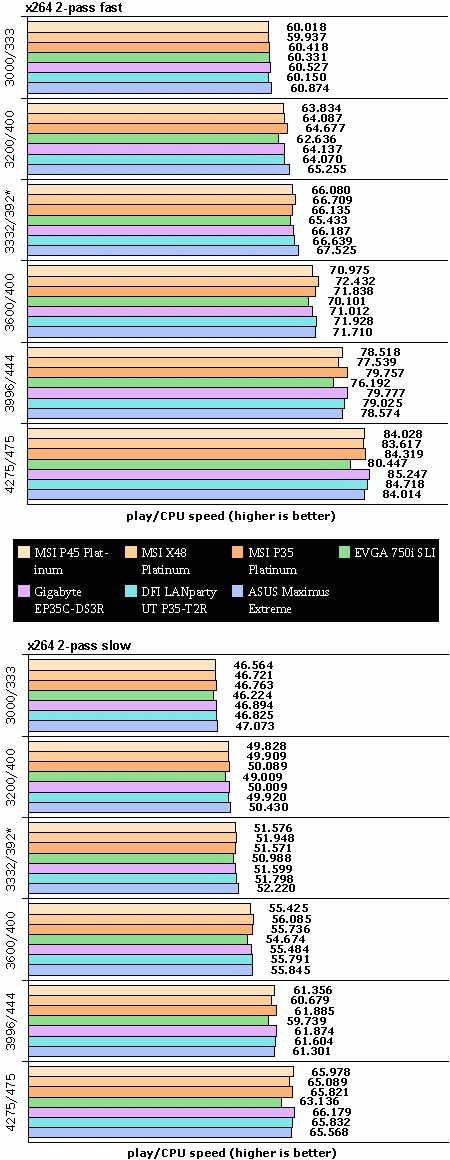
*Note: The DFI P35 mainboard doesn't support half multipliers, so it was using 417x8.
LameMT:
The same episode we encoded, we used for our MP3-testing. We don't recommend using MP3 for encoding, because AC3 can do the job better, but nearly 42 minutes gives us approximately the length of any given album.
A measurement in seconds, as many sites do, is useless, because the differences are too small. So we used the built-in play/CPU ratio, this means the CPU is encoding x-times faster then the track-length. Fast memory does not play an important role here. For your convenience we also show the single-threaded benchmarks figures, they can be re-produced with any version of L.A.M.E. Only LameMT can do multi-thread and take advantage of multi-core processors.
We used this setting: lamemt --vbr-new -q 2 -V 2 -m j --strictly-enforce-ISO --resample 48
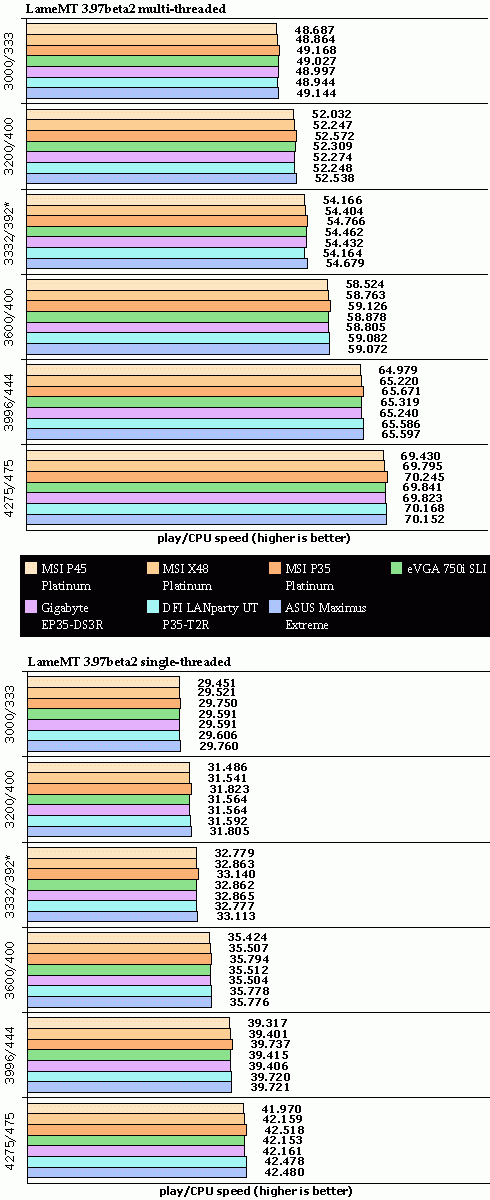
*Note: The DFI P35 mainboard doesn't support half multipliers, so it was using 417x8.