Index
Before we move to testing let's say that support for even only 95W is quite okay, as these boards are supposed to be used for lower-end systems and HTPC; most of the Phenoms will be an overkill for such a system because the 780G is capable of decoding VC1 and MPEG streams.
Benchmarks:
Please note that different BIOS revisions may give different results. All benches are done with 1.20VCore for the CPU and CL5-5-5-15CR2T settings. Northbridge voltage was increased by about 0.2V for overclocking the graphics-core.
x264:
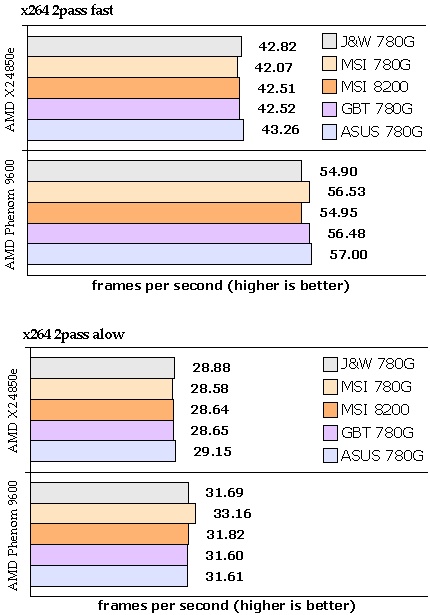
x264 is a h.264/AVC codec which supports four threads, and it's available for free. We took a PAL episode of "Babylon 5" with a length of 41 minutes, 57 seconds and 8 frames. We tried to "emulate" the most common usage when you encode your movies:
1st: We have a perfect master, so we only de-interlace the content and resize it without any other manipulations; we marked this as "fast."
2nd: You get bad mastering on many DVDs, especially "old" stuff or when the studios are in a hurry for the release. In this case you want to improve the picture quality, which is done by filtering the content. You can choose from lots of filters for any purposes you can think of, but we only used the most common "undot," "FluxSmooth" and "MSharpen." Of course, we also de-interlaced, filters were done before any resizing took place (which is slower). We marked this as "slow."
3DMark:
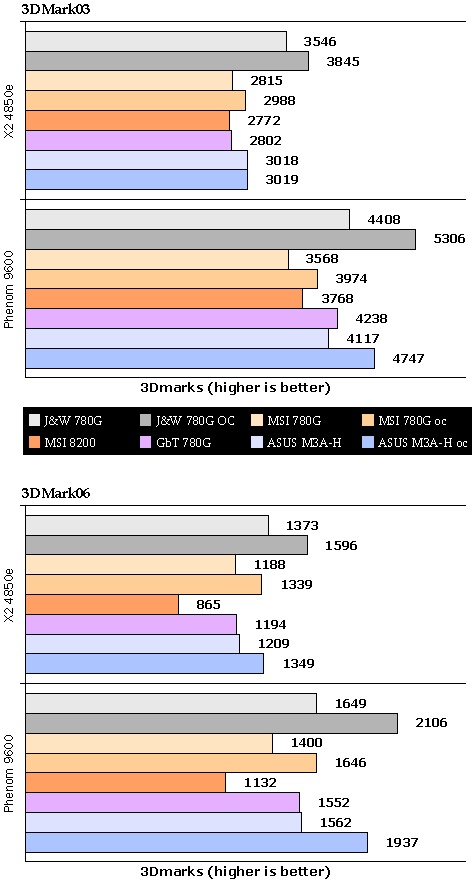
Some of the features of the 780G and 8200, such as Hybrid Power and Hybrid Crossfire/SLI, are exclusive to Vista which is more than lame. While testing the mainboards we didn't use "the broken" OS because it's in most cases slower compared to Windows XP. Hybrid Crossfire only helps marginally, but for a few bucks more you get a decent graphics card, which is always the better choice.
You can see that Phenom is per clock faster, as it run at 2.30GHz, while the 4850e runs at 2.50GHz. Also the sideband-memory does help, but with a bit fine-tuning ASUS comes quite close. The GeForce 8200 is a big disappointment. While we have expected it to be a bit slower, it's way behind AMD and not a choice for casual gamers at all.
J&W, MSI and ASUS overclock to 850MHz, while Gigabyte is stuck at 750MHz, so we skipped it. With 850MHz the onboard graphics surpasses a HD3450 card, especially with sideband-memory.