Featured Articles

After USA Nvidia’s Shield comes elsewhere

After USA Nvidia’s Shield comes elsewhere

Project Shield, which is now called Nvidia Shield, is up for preorder, at least if you’re in North America. For…

More...
Nvidia won most Haswell high-end notebooks

Nvidia won most Haswell high-end notebooks

Our sources in the Far East are claiming that most Haswell notebooks that are coming out in the next few weeks…

More...
Microsoft officially announces the Xbox One

Microsoft officially announces the Xbox One

As announced earlier, Microsoft has now finally unveiled its next-generation console, the Xbox One. Although it did not shed much light…

More...
AMD poaches more Nvidia talent

AMD poaches more Nvidia talent

AMD has apparently managed to grab yet another high-ranking Nvidian, but this time it was no engineer or developer.

More...
HIS iCooler Turbo HD 7790 reviewed

HIS iCooler Turbo HD 7790 reviewed

Today we’ll take a closer look at a factory overclocked HD 7790, courtesy of HIS. The HIS HD 7790 iCooler Turbo…

More...
Frontpage Slideshow | Copyright © 2006-2010 orks, a business unit of Nuevvo Webware Ltd.
Friday, 02 March 2007 10:20

PowerColor Introduces X1950 PRO Silence Edition

Written by Fuad Abazovic
Image

Arctic cooling passively cools RV570


PowerColor
decided to introduce one of the last Radeon X1950 PRO cards on a market and the company decided to make a difference.


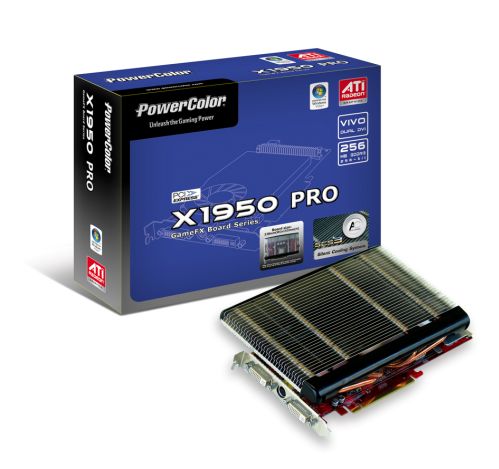
The company introduced a passively cooler X1950 PRO card running at 575 MHz core and 1380 MHz memory. It decided to use Arctic cooling S1 and this massive passive chunk of metal is able to cool this card, without any noise. The card is equipped with 256 MB GDDR 3 memory and has 36 Pixel Shaders. It also supports Vivo, HDCP and works well under Windows Vista.

Image 


This specially designed silent cooler features four heat pipes, special voltage regulator heat sink memory cooling and taller fins. The passive part of the card is huge but there is no any noise out of the cooler. The S1 based cooler doesn’t have any active, moving parts or fans. The temperature stays around 63 Degrees Celsius while the reference cooler can only do 67 Degrees Celsius. The passive part beats the ATI's reference cooling, now that is something to be proud off.  

 
This cooler actually has four heat pipes to help it with a hard task of cooling. The samples are available now and the card should debut at Cebit.


Last modified on Friday, 02 March 2007 12:01
blog comments powered by Disqus

To be able to post comments please log-in with Disqus


Facebook activity

Latest Commented Articles

Recent Comments