
Featured Articles

After USA Nvidia’s Shield comes elsewhere

After USA Nvidia’s Shield comes elsewhere

Project Shield, which is now called Nvidia Shield, is up for preorder, at least if you’re in North America. For…

More...
Nvidia won most Haswell high-end notebooks

Nvidia won most Haswell high-end notebooks

Our sources in the Far East are claiming that most Haswell notebooks that are coming out in the next few weeks…

More...
Microsoft officially announces the Xbox One

Microsoft officially announces the Xbox One

As announced earlier, Microsoft has now finally unveiled its next-generation console, the Xbox One. Although it did not shed much light…

More...
AMD poaches more Nvidia talent

AMD poaches more Nvidia talent

AMD has apparently managed to grab yet another high-ranking Nvidian, but this time it was no engineer or developer.

More...
HIS iCooler Turbo HD 7790 reviewed

HIS iCooler Turbo HD 7790 reviewed

Today we’ll take a closer look at a factory overclocked HD 7790, courtesy of HIS. The HIS HD 7790 iCooler Turbo…

More...
Frontpage Slideshow | Copyright © 2006-2010 orks, a business unit of Nuevvo Webware Ltd.
Wednesday, 21 March 2007 21:25

Zalman Reserator XT

Written by test1


Image

CEBIT 2007: From passive to hybrid


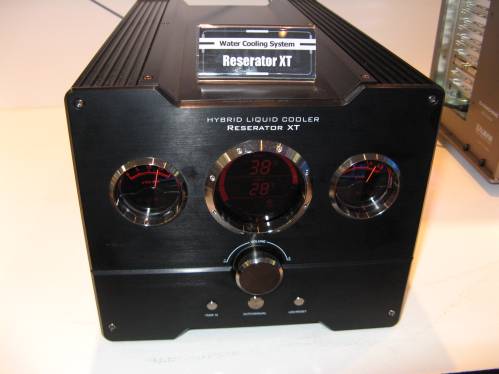
Zalman is setting a new course for its Reserator water cooling line up. Instead of using bulky, heavy, and expensive passive solutions also known as Reserator series from now on Zalman will be using a combination of passive and active cooling. Hybrid cooling will result with better cooling at minimum noise levels.


The new Hybrid water cooling is a complete system that is able to monitor its work and react automatically on errors. If a critical error occurs, the AI inside the Reserator will initiate shut down procedure and save your PC. Integrated controlling system allows the user to fine tune the performance of the cooler. The cooler can work on fully automatic or manual modes. In manual mode fan and pump speed can be adjusted via large knobs on front of the chassis.


Both passive and active cooling are used to cool the coolant. The active part consists of a 140mm fan and water cooling radiator. Most of the heat will be dissipated with this part of the cooling system. A smaller amount of the heat is passively transferred from the fluid to the aluminium chassis via natural convection. As we said, combining these two solutions will yield better results than only passive solutions.


Price is yet to be announced.
 

Image 

Last modified on Wednesday, 21 March 2007 22:03

test1

E-mail: This e-mail address is being protected from spambots. You need JavaScript enabled to view it
blog comments powered by Disqus

To be able to post comments please log-in with Disqus


Facebook activity

Latest Commented Articles

Recent Comments