Index
Gainward GTX 680 temperatures go up to 80°C during gaming. Although this may seem a bit high, it’s still good considering the satisfactory noise levels. The GTX 680’s fanproduces a bit more noise compared to GTX 580 ones, but it is still audibly quieter than the HD 7970.
Playing games at reference Base clock (1006MHz) resulted in 13 different GPU clocks, starting from 1006MHz and ending with 1110MHz (Boost clock 1059MHz). Note that there were no sudden changes in fan noise. 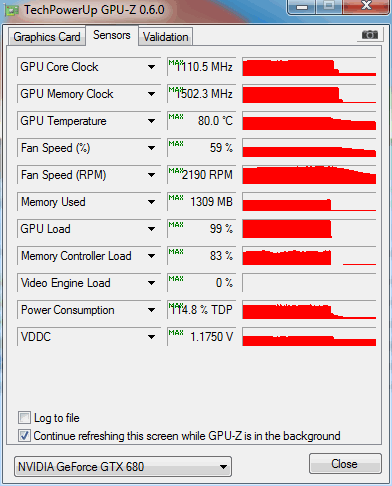
At the same time, 82°C was a stable temperature that allows further overclocking headroom. 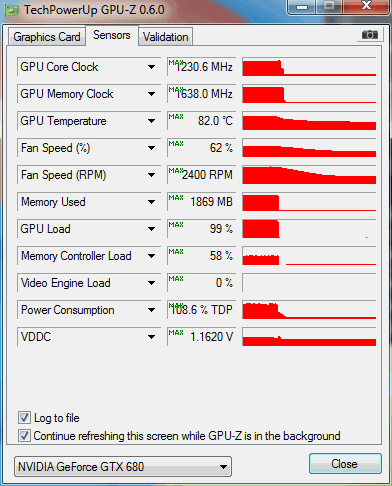
That the cooler is potent was clear from our testing. Namely, we manually sped up the fan to 85% and the temperature dropped from 82°C to 66°C. However, the fan was already too loud at 4000RPM.
Note however the codependency between thermals and clock calculations, which may result in different performance depending on thermals. As soon as the card overheats, which causes current leakage increases, GPU Boost will decrease clocks and voltage. Our additional “overclocking” resulted in +133MHz offset for the Base clock, i.e. maximum clock of 1230MHz, but playing games at 2560x1600 resolution resulted in average clocks at and around 1166MHz.
Power Consumption
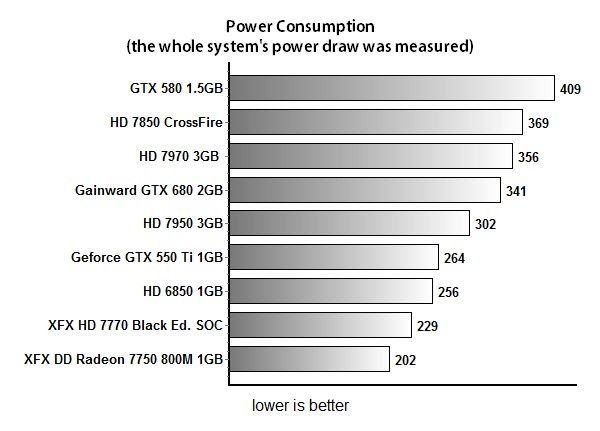
GTX 680’s power consumption is better than that of its main competitor – HD 7970. At the same time, GTX 680 is faster which gives it an edge here. However, AMD’s card boasts ZecoCore, a feature that shuts the card down once the display is off, which slashes consumption to mere 1W. The same scenario will see the GTX 680 consume about 14W. Still, GTX 680’s power management is definitely a job well done because the card scores more than 20% better than its predecessor GTX 580 while consuming 50W+ less.