Featured Articles

Gainward GTX 780 3GB previewed

Gainward GTX 780 3GB previewed

The Gainward GTX 780 is now available priced at about US $649/€649, but we're hoping it will be available for a…

More...
GTX 780 available in US stores

GTX 780 available in US stores

The GTX 780, a trimmed down version of the Geforce Titan, is out and we wrote that almost a dozen…

More...
Newegg claims Shield comes on June 30

Newegg claims Shield comes on June 30

It is no secret that for the last few days you can pre-order Nvidia Shield, at least if you are based…

More...
Nvidia officially launches the GTX 780

Nvidia officially launches the GTX 780

Just as we wrote a couple of days ago, Nvidia has picked the 23rd of May as the official launch date…

More...
HIS iCooler Turbo HD 7790 reviewed

HIS iCooler Turbo HD 7790 reviewed

Today we’ll take a closer look at a factory overclocked HD 7790, courtesy of HIS. The HIS HD 7790 iCooler Turbo…

More...
Frontpage Slideshow | Copyright © 2006-2010 orks, a business unit of Nuevvo Webware Ltd.
Wednesday, 19 January 2011 10:24

EVGA GTX 570 Superclocked tested - 7. Overclocking, Thermals

Written by Sanjin Rados
570-sc-front-thumb

Review: Reference design, higher clocks


Overclocking

As its name suggests, EVGA GTX 570 Super Clocked is a factory overclocked graphics card. Its GPU runs at 797MHz and the memory at 975MHz. Just to remind you, Nvidia’s reference clocks for this card are 732MHz for the GPU and 950MHz for the memory.
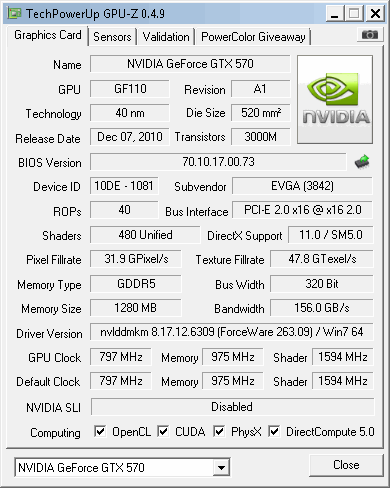
evga_gtx_570_SC_gpuz

A 65MHz GPU overclock is a respectable one and will surely bring about visible performance increase. However, any additional overclocking on our card was limited by the core’s voltage.

MSI Afterburner 2.1.0 Beta 5 reports that the card’s default voltage is 988mV, which limited us to 810MHz for the GPU.
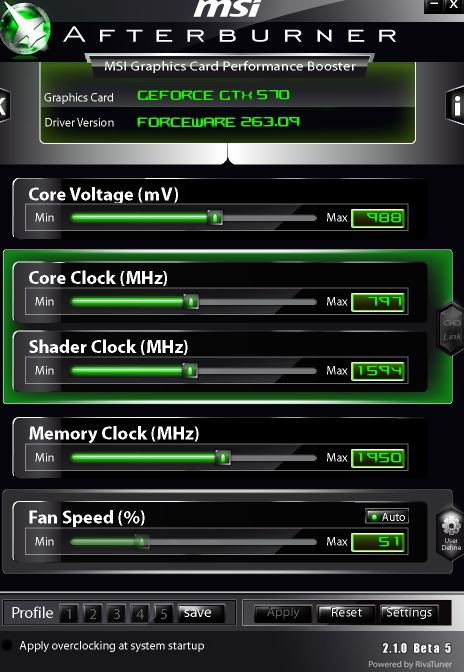
evga_570_sc_afterburner

We pushed the core voltage to 1088mV and achieved stable 870MHz, which was the maximum we managed. Note that Afterburner 2.1.0 Beta 5’s maximum voltage is 1100mV, but further voltage increases didn’t do much to improve our overclocking results. We managed to push the memory to 1110MHz (4440MHz effectively).
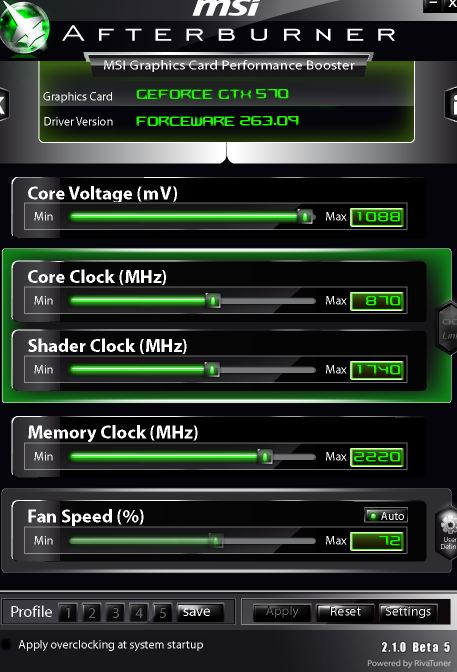
evga_570_sc_afterburner_oc


Thermals and Noise

As far as noise levels go, the GTX 570 SC’s cooler is almost inaudible when idle, with GPU temperature around 45°C. While the GTX 570 SC isn’t too loud during operation, it was the loudest piece of equipment in our rig. In our case, intensive 3D resulted in GPU temperature of about 86°C.


 

(Page 7 of 8)
Last modified on Wednesday, 19 January 2011 12:00
blog comments powered by Disqus

To be able to post comments please log-in with Disqus


Facebook activity

Latest Commented Articles

Recent Comments