Featured Articles

Intel plans Haswell refresh in Q2 2014

Intel plans Haswell refresh in Q2 2014

Intel has been executing its tick tock strategy flawlessly since January 2006 and now there is some indication that we might…

More...
Xbox One demoed running GTX card

Xbox One demoed running GTX card

It looks like the Xbox One just cannot catch a break. We have stumbled upon a report claiming that Xbox One…

More...
Haswell Pentium and Core specs surface

Haswell Pentium and Core specs surface

Haswell is out and now we have the complete specs for Intel’s first batch of fourth generation Core parts, as well…

More...
EVGA GTX 770 ACX 2GB previewed

EVGA GTX 770 ACX 2GB previewed

Nvidia is hoping that the Geforce GTX 770 will be a very popular product, and EVGA obviously share this view, as…

More...
Gainward GTX 770 Phantom reviewed

Gainward GTX 770 Phantom reviewed

Gainward has now officially unveiled its custom version of the Geforce GTX 770, the Gainward GTX 770 Phantom. Based on the…

More...
Frontpage Slideshow | Copyright © 2006-2010 orks, a business unit of Nuevvo Webware Ltd.
Monday, 10 May 2010 12:50

Intel H55, G6950 and i3-530 tested - 4 Power-Consumption

Written by Eliot Kucharik

Image Image

Review: Too expensive to compete against AMD?


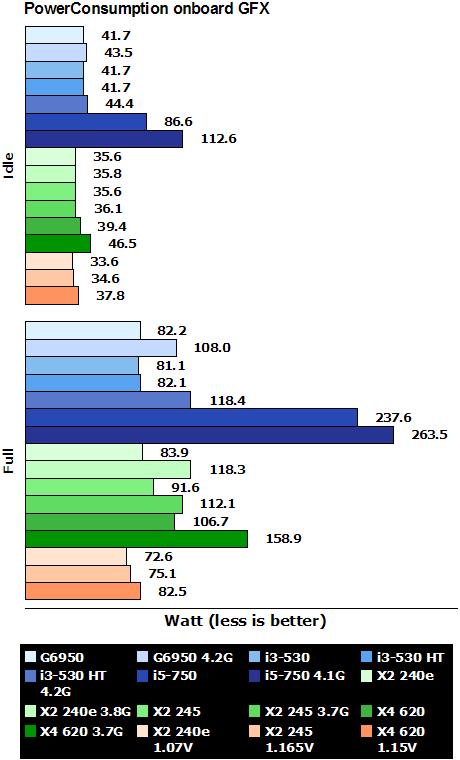
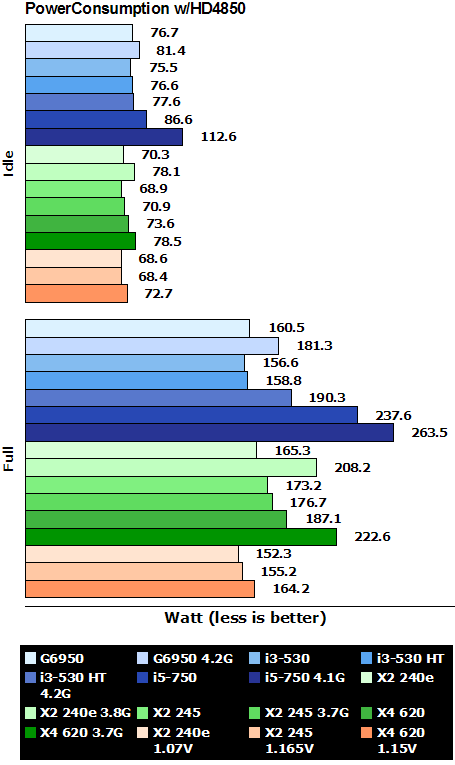
Both CPU feature a 73W envelope with the H55 rated at 5.2W. AMD CPUs have a lower TDP but the combination of 785G and SB750 does require more power. Surprisingly AMD has the lead in the idle power consumption, while of course Intel fares better under load. As we have shown, you can under-voltage AMD CPUs very well, so even AMD can be competitive in power-consumption. We have no included a second monitor to our scores, but here Intel leads with a surplus of only about 3W, compared to AMD which requires about 8W more for the second screen. With two screens both platforms consumes about the same power in idle. Please note that the i5-750 platform run on the MSI P55-GD65 platform with an HD 4850 installed.
Image

Image


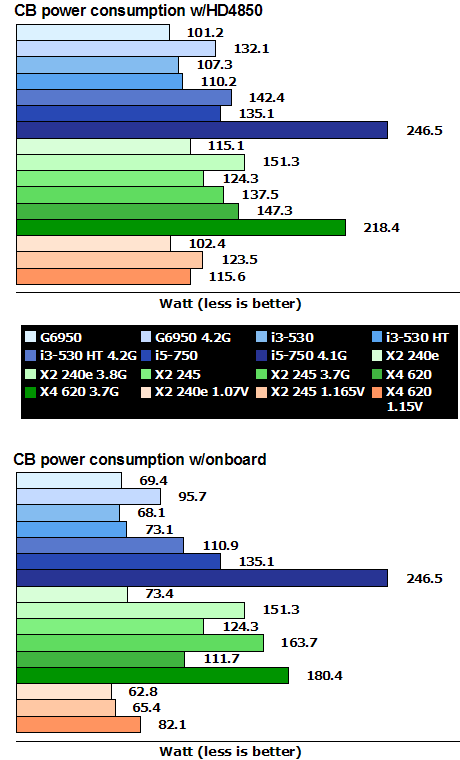
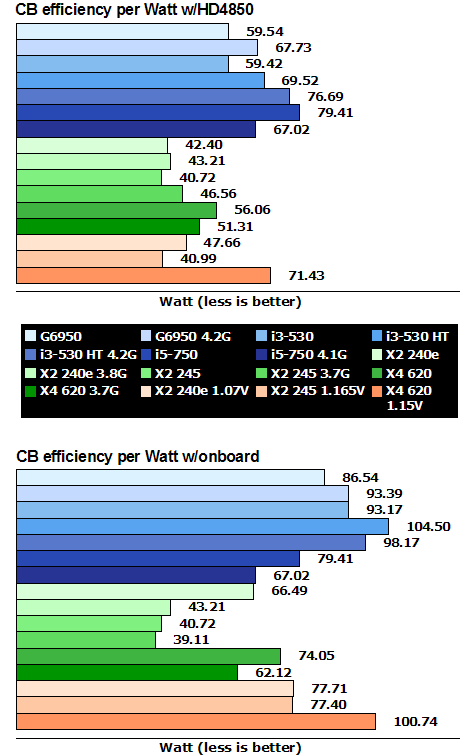
In our performance/wattage check with Cinebench we see AMD is closer as thought, especially when under-voltaged. That is because standard boards do not waste power with features nobody needs, such as ten, twelve, sixteen or 32 phases and with less add-on chips.
Image

Image


(Page 4 of 6)
Last modified on Friday, 24 September 2010 20:29
blog comments powered by Disqus

To be able to post comments please log-in with Disqus


Facebook activity

Latest Commented Articles

Recent Comments