Featured Articles

Microsoft officially announces the Xbox One

Microsoft officially announces the Xbox One

As announced earlier, Microsoft has now finally unveiled its next-generation console, the Xbox One. Although it did not shed much light…

More...
AMD poaches more Nvidia talent

AMD poaches more Nvidia talent

AMD has apparently managed to grab yet another high-ranking Nvidian, but this time it was no engineer or developer.

More...
Qualcomm and Samsung overtake AMD

Qualcomm and Samsung overtake AMD

It’s no secret that the mobile boom is taking a toll on makers of PC components and AMD is one of…

More...
Nvidia Geforce GTX 780 detailed

Nvidia Geforce GTX 780 detailed

We managed to confirm the full spec of the upcoming Nvidia Geforce GTX 780 graphics card as well as some performance…

More...
HIS iCooler Turbo HD 7790 reviewed

HIS iCooler Turbo HD 7790 reviewed

Today we’ll take a closer look at a factory overclocked HD 7790, courtesy of HIS. The HIS HD 7790 iCooler Turbo…

More...
Frontpage Slideshow | Copyright © 2006-2010 orks, a business unit of Nuevvo Webware Ltd.
Tuesday, 19 January 2010 17:06

ASRock Ion330HT-BD im Detail - 4 Testen

Written by Eliot Kucharik

Image Image

Review: Ein idealer Multimedia Player?


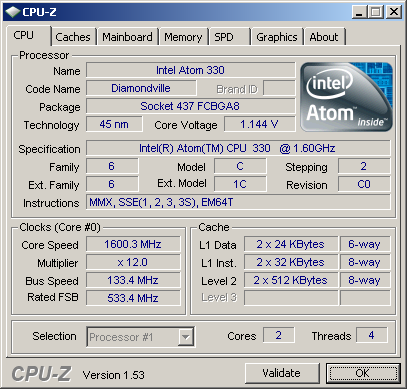
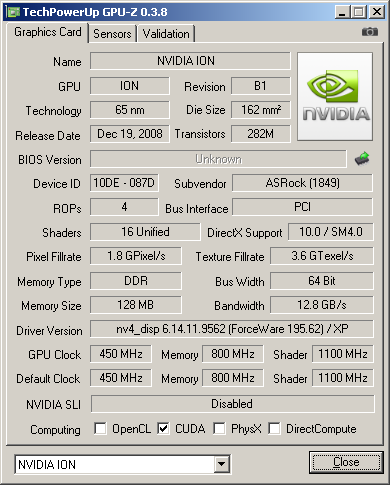
Natürlich haben wir mittels CPUz und GPUz die Spezifikationen ermittelt, die auch bestätigt wurden.
Image

Image


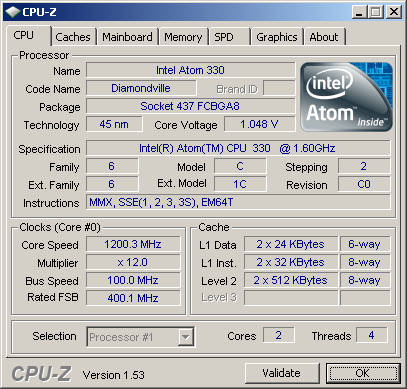
Wie Ihr Euch vorstellen könnt, ist das Installieren von Windows XP und Windows 7 etwas langsam. Überraschenderweise booten beide Systeme in knapp unter 35 Sekunden, sehr ansprechend bei einem derart lahmen Prozessor. Während dem normalen Arbeiten auf der Maschine, ist uns das hochtönige Surren des alten 3cm Lüfters sehr nervig aufgefallen. Als Konsequenz haben wir das Board ausgebaut, den Lüfter entfernt und den Prozessor und den Ion heruntergetaktet. Leider gibt es nicht viel Spielraum im BIOS, daher haben wir den FSB auf 100 gesenkt und die VCore auf den niedrigsten verfügbaren Wert eingestellt. Selbiges geschah auch mit dem Ion, allerdings ist dieses BIOS derzeit noch nicht öffentlich erhältlich. Damit läuft der Atom 330 nun nur noch mit 1.20GHz, der Ion mit 300/800MHz. Das ist mehr als ausreichend und wir haben keine größeren Verzögerungen festgestellt. Nachdem wir einen neuen Lüfter von ASRock erhalten hatten, wurde dieser natürlich eingebaut und getestet. Das hochtönige Surren ist jetzt stark reduziert, aber der Lüfter immer noch hörbar. Das liegt daran, daß das Gehäuse die Lüftergeräusche verstärkt.
Image


(Page 4 of 6)
Last modified on Friday, 24 September 2010 20:33
blog comments powered by Disqus

To be able to post comments please log-in with Disqus


Facebook activity

Latest Commented Articles

Recent Comments