
Index
Review: Reference clocks with non-reference Arctic Cooling
After our sneek peek at AXLE's GT 240 and GT 220 offer, today we follow up with a full review on what these cards bring to the table. In case you've forgotten, these cards have been launched only recently and are particularly interesting for their GPU, which is built in 40nm. These are Nvidia's first 40nm based cards, although Nvidia's 40nm graphics isn't set to shine until 2010, when Fermi-based cards hit the market.
Another important and highly anticipated feature on Nvidia's cards is DirectX 11 support, although GT 240/220 cards are more of a transition towards the new API, as they support DX10.1, but not DX11.
Performance wise, the GT220 is set to replace the Geforce 9500 family whereas the GT240 should succeed the Geforce 9600. Both cards are lower end desktop cards, but they're more than enough for most average users who aren't quite keen on gaming at higher resolutions and more demanding effect settings. In case you're looking into buying these cards for multimedia purposes, rest assured that the cards will do the trick. In fact, on these cards Nvidia finally remedied the problem of required additional connections when bringing audio and video to your HDTV. Nvidia owners remember (or still perform) the routine where audio had to be routed separately from the soundcard's/motherboard's SPDIF out to the card's SPDIF in. Apart from the standard DVI and VGA ports, both AXLE cards have native HDMI out.
These cards have great consumption specs, thanks to the 40nm core. GT220 will consume only 7W when idle, whereas GT240 consumption is 9W. Maximum consumption for the GT220 and GT240 is 58W and 70W respectively, which means that PCI-Express power will be enough to spin these cards and no additional power is required.
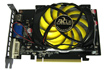
AXLE Geforce GT220 features 48 shader processors (CUDA cores), the core runs at reference 625MHz, where the shaders run at 1360MHz. AXLE left the memory running at reference 790MHz and equipped the card with 1GB of GDDR3 with a 128-bit interface, which is a common feature in this price segment. The GT220 comes with 8 ROP units and 16 texture filter units. The card is priced at €50 and you can see it on the picture below.
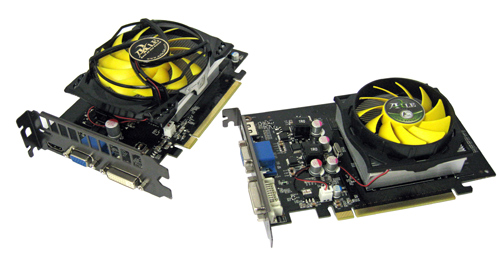
The second card on our test, also coming from AXLE, is the GT 240 (on the picture above, left) and it performs significantly faster than the GT 220. The GT240 is based on the GT215 core and packs a total of 96 shader processors, meaning twice the number of shaders on the GT220. The AXLE GT240's GPU runs at reference 550MHz whereas the shaders are at 1340MHz. This card is priced between €70-80.
We've already said that GT240 offers much better performance compared to the GT220, and it's evident after looking at the bandwidth these cards offer. Thanks to the GDDR5 memory running at 1700MHz, GT240 has 54.4GB/s bandwidth, whereas the GT220's GDDR3 memory results in only 25.3GB/s.
Before we move on to gaming result, let's take a closer look at the cards.