
Index
Page 1 of 4

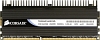
Review: Faster memory doesn't help the i7
With the new Intel Core i7 platform, memory makers are required to make new kits because it's using triple-channel, which only slightly enhances performance. More important is that Intel is limiting the memory voltages to 1.65V. While it was commonly seen as reasonable to offer fast memory with quite insane voltages, now all memory makers have to select better chips and finally power-consumption will come down too.
In our coverage of Intel's new platform we have tested some memory settings, but our BIOS did not allow us to use 1600MHz due to its beta status. Meanwhile Intel was working hard and has improved the BIOS with new options and increasing the memory multiplier to 14.
The overall problem with faster memory on this platform is, it requires to overclock the CPU cache, so it needs higher voltages, which also will increase power consumption dramatically. Today we'll find out if faster memory does the i7 any good.
Testbed:
Motherboard:
Intel DX58SO "Smackover" (provided by Intel)
Intel X58/iCH10R
CPU:
Intel Core i7 965XE (provided by Intel)
CPU-Cooler:
Thermalright Ultra 120 eXtreme 1366 (provided by Thermalright)
Memory:
Qimonda 3GB Kit PC3-8500U (provided by Qimonda)
CL7-7-7-20 CR1 @1.50V
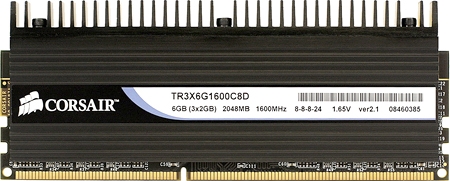
Corsair 6GB Kit PC3-12800 TR3X6G1600C8D (provided by Corsair)
CL8-8-8-24 CR2 @1.65V
Graphics Card:
Jetway Radeon HD3870 (provided by mec-electronics)
Power supply:
Seasonic S12-II 500W
Harddrive:
Samsung Spinpoint F1 500GB
Case fans:
SilenX iXtrema Pro 14dB(A) (provided by PC-Cooling.at)
Case:
Cooler Master Stacker 831 Lite (provided by Cooler Master)
Prev Next »