
Index
SMT aka Hyperthreading:
An old acquaintance made it back into Nehalem: Hyperthreading. While with a P4 this feature was important to get some juice out of the Netburst architecture, it is not necessary for Nehalem at all, because this CPU is fast on its own. But Hyperthreading or as Intel calls it SMT, does only require about 5% more transistors but can increase the performance up to 30%. With some applications, however, it will considerably slow down performance, so you have to test for yourself if your applications will benefit from it. There is no general rule to say which is better. This slowed down our benching efforts, because we had unexplainable slow benches and to look into it took us considerable time; at least now you know and we will show you the results in our review.
Design with Power Consumption in mind:
A big difference from previous designs is the approach Intel went through to improve performance. The old CPUs were designed with the 1:1 law, so if you improve the performance 1%, it can cost 1% of additional power. Nehalem is "greener" because now 2% of performance is limited to 1% more power consumption. Overall, we can say idle performance was great, but overall power consumption can be higher as current Penryn offers.
Overclocking and Turbo Mode:
Overclocking is our only concern, as things went quite wrong. We were used to the fact that playing around with the FSB and increasing it increased performance, as well. Due to QPI there is no FSB, same as Athlon CPUs, but you still get a host clock. This went down to the 133MHz we knew from before the quadruple FSB was introduced. All frequencies are now calculated with that clock.
If you get an Extreme CPU it's somewhat easier. Intel introduced a Turbo Mode, which means, the CPU can overclock itself when demanding applications run. On the other hand, this leaves the idle power at its lowest level. Increasing the TDP, the maximum current and dynamic overvoltaging got us to 4GHz easily.
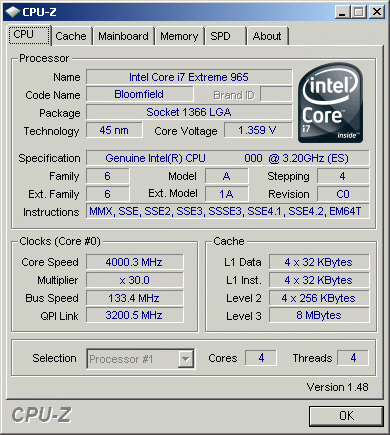
For non-Extreme editions that will get tricky. You have to increase the host clock, need to reduce the clocks for memory and QPI and also the chipset needs more juice. On our "Smackover" Intel board, this is really a mess, because every setting is in a different BIOS screen und the BIOS does not calculate any frequencies for you, so a table-calculator will help. We hope other vendors will do this in a smarter way.
Stay tuned for the review, which will be online as soon as possible.