Featured Articles

After USA Nvidia’s Shield comes elsewhere

After USA Nvidia’s Shield comes elsewhere

Project Shield, which is now called Nvidia Shield, is up for preorder, at least if you’re in North America. For…

More...
Nvidia won most Haswell high-end notebooks

Nvidia won most Haswell high-end notebooks

Our sources in the Far East are claiming that most Haswell notebooks that are coming out in the next few weeks…

More...
Microsoft officially announces the Xbox One

Microsoft officially announces the Xbox One

As announced earlier, Microsoft has now finally unveiled its next-generation console, the Xbox One. Although it did not shed much light…

More...
AMD poaches more Nvidia talent

AMD poaches more Nvidia talent

AMD has apparently managed to grab yet another high-ranking Nvidian, but this time it was no engineer or developer.

More...
HIS iCooler Turbo HD 7790 reviewed

HIS iCooler Turbo HD 7790 reviewed

Today we’ll take a closer look at a factory overclocked HD 7790, courtesy of HIS. The HIS HD 7790 iCooler Turbo…

More...
Frontpage Slideshow | Copyright © 2006-2010 orks, a business unit of Nuevvo Webware Ltd.
Monday, 08 October 2007 09:49

OCZ DDR3 1600MHz goes 1800MHz+ - 4 Synthetic benches

Written by Eliot Kucharik

Image


Review:
Next generation kit


Benches:
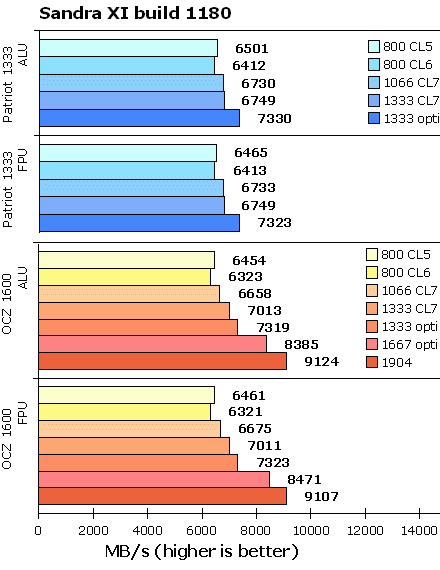
For memory reviews we used synthetic benchmarks, so that we can better compare them to real world applications. The OCZ Kit is slower in lower speeds compared to Patriot, but improves the higher the speed. We could bench memory with 1904MHz, but memory intensive applications such as GordianKnot crashed. As always speed improves with a higher FSB.

Image


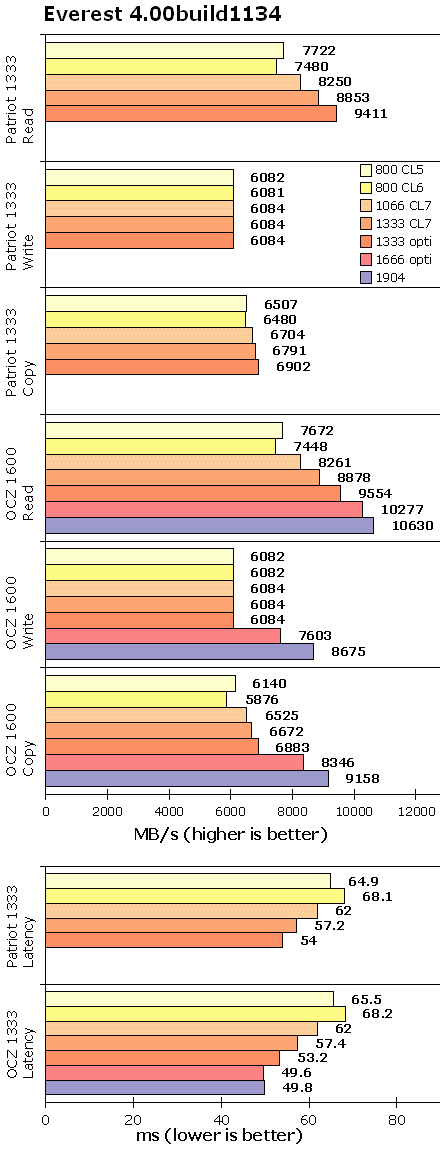
Everest benchmarks shows no significant differences. Of course, higher clockspeed can improve the rates and we compared scores only at the same CPU speed.

Image


Everest also benchmarks the latency, higher clocks means more latency, but low frequency with low latency needs higher latency on the chipset, which increases access latency a lot. On our board the chipset latency was locked with "Boost 0" settings, so only the frequencies were altered.

(Page 4 of 5)
Last modified on Monday, 22 October 2007 10:00
blog comments powered by Disqus

To be able to post comments please log-in with Disqus


Facebook activity

Latest Commented Articles

Recent Comments