
Featured Articles

Nvidia GTX 770 spec is out

Nvidia GTX 770 spec is out

In addition to the GK110 based Nvidia Geforce GTX 780, we managed to get some details regarding the GK104-based GTX 770…

More...
Nvidia Geforce GTX 780 detailed

Nvidia Geforce GTX 780 detailed

We managed to confirm the full spec of the upcoming Nvidia Geforce GTX 780 graphics card as well as some performance…

More...
AMD shares take rollercoaster ride

AMD shares take rollercoaster ride

In the last 52 weeks AMD was on a rollercoaster ride, with prices ranging from $1.81 to $6.46. Yesterday it closed…

More...
HIS iCooler Turbo HD 7790 reviewed

HIS iCooler Turbo HD 7790 reviewed

Today we’ll take a closer look at a factory overclocked HD 7790, courtesy of HIS. The HIS HD 7790 iCooler Turbo…

More...
Kingston DataTraveler Ultimate 3.0 Generation 3 (32GB) reviewed

Kingston DataTraveler Ultimate 3.0 Generation 3 (32GB) reviewed

High capacity USB drives have become commonplace a while ago, but although some memory outfits are peddling huge drives, up…

More...
Frontpage Slideshow | Copyright © 2006-2010 orks, a business unit of Nuevvo Webware Ltd.
Thursday, 12 March 2009 08:36

Fusion-io is readying 1.28TB SDD

Written by test

Image

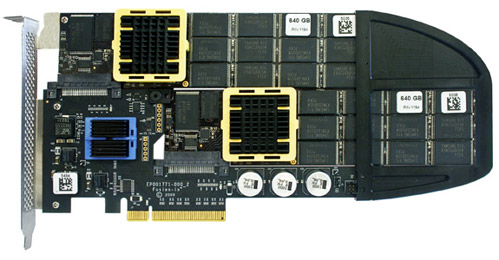
The ioDrive Duo

Although OCZ was showing off a 1TB SSD drive during CeBIT, it seems like by the time it becomes available, Fusion-io will have an even bigger drive ready, as its new ioDrive Duo will have reached 1.28TB in size by then.

Fusion-io came up with a clever way of designing these new SSDs, although just as with the drive from OCZ, the ioDrive Duo is based on a PCI Express card. However, they're using a pair of slot-in SSD modules which seems to suggest that Fusion-io might be doing some kind of dual channel SSD magic here. Considering the rated sustainted read speed of 1,500MB/s and write speed of 1,400MB/s one has to wonder what Fusion-io has done.

The ioDrive Duo is available from April in capacities of 160, 320 and 640GB with the 1.28TB drive coming out sometime in the second half of the year. All drives use either a PCI Express 1.0 x8 or a PCI Express 2.0 x4 interface to connect to the host system. No pricing has been revealed, but expect them to be expensive.

You can find the press release here
Image
Last modified on Thursday, 12 March 2009 09:26
blog comments powered by Disqus

To be able to post comments please log-in with Disqus


Facebook activity

Latest Commented Articles

Recent Comments